
Charter 14 : Cycle Transitions: Puberty & Perimenopause
🕒 10 min read | Module: Troubleshooting ⏳
The cycle is a journey, not just a destination.
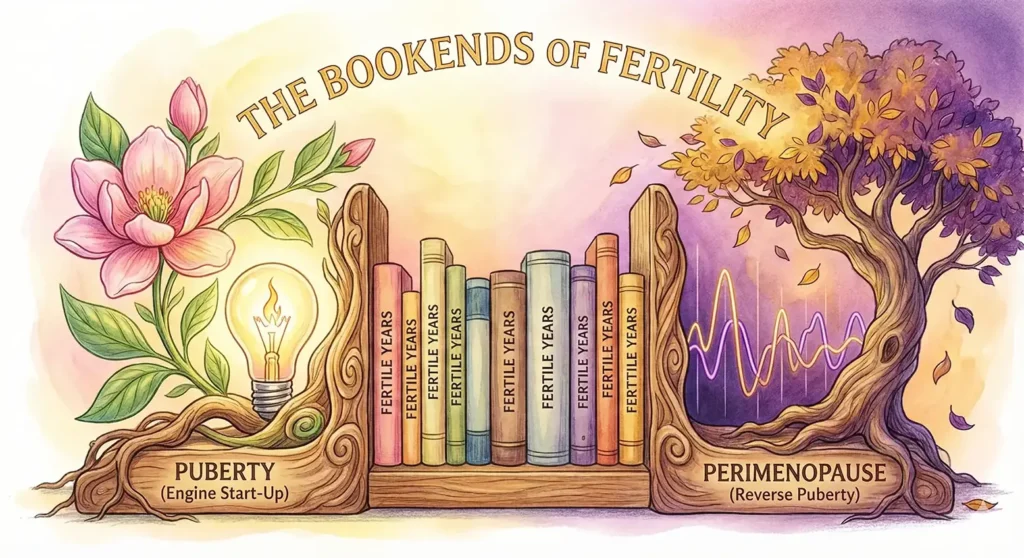
We spend most of our lives focusing on the fertile years in the middle. But the beginning (Puberty) and the winding down (Perimenopause) are often the most turbulent times in a woman’s life.
Think of them as the Bookends of Fertility. In both phases, the brain and ovaries are struggling to communicate clearly, leading to hormonal static. This results in heavy bleeding, mood swings, and confusion.
In this chapter, we bridge the gap. Whether you are a mother guiding a daughter, or a woman navigating the shifts of her 40s, understanding these transitions turns fear into empowerment.
💡 Key Takeaways
- Puberty: The HPO axis is just warming up. Irregular periods are normal for the first 2-3 years.
- Perimenopause: It is ‘Reverse Puberty.’ It can start as early as 35, lasting up to 10 years before menopause.
- Progesterone Drops First: In your 40s, you lose the calming hormone first, leading to anxiety and insomnia.
- The Anovulatory Factor: Both phases feature cycles without eggs, causing heavier, painless bleeding or skipped months.
1. Puberty: The Engine Start-Up
When a girl gets her first period (Menarche), her body isn’t an expert yet. The communication line between her brain and ovaries (the HPO Axis) is flickering on, like a fluorescent light bulb.
- Irregularity is Key: It is completely normal for a teen to skip months. Her body is learning how to ovulate.
- Heavy & Painful: Because she might not ovulate every month, she doesn’t make enough Progesterone (which thins the lining). This allows Estrogen to build up a thick lining, leading to heavy, clotty, and painful periods.
2. Perimenopause: The Reverse Puberty
Most women think menopause happens in their 50s. But Perimenopause (the transition) often begins in your late 30s or early 40s. It is literally puberty in reverse.
The Pattern of Decline:
- Progesterone leaves the party first: You stop ovulating consistently. This means less calming progesterone. Result: sudden anxiety, insomnia, and shorter cycles (21-24 days).
- Estrogen goes on a rollercoaster: Without progesterone to balance it, estrogen spikes and crashes. Result: sore breasts, heavy bleeding, and fibroids.
- Estrogen finally drops: This happens closer to actual menopause (around 50). Result: hot flashes and vaginal dryness.
3. Managing the Chaos (40s Edition)
If you are in your 40s, you are likely sandwich-generation stressed (caring for kids and parents). But your body has zero tolerance for stress now.
- Protect your Sleep: Lack of progesterone ruins sleep. Prioritize sleep hygiene above all else.
- Consider Magnesium: Many women find it helps calm the nervous system (always consult your doctor before starting supplements, especially if you experience heart palpitations).
- Heat for Nervous System Regulation: You might feel ‘tired but wired.’ Using heat therapy on your neck or belly helps manually switch your body into relaxation mode.
4. When is it officially Menopause?
Menopause is just one day. It is the day marking 12 consecutive months without a period. Everything before that day is Perimenopause. Everything after is Post-Menopause.
Once you reach post-menopause, your ovaries retire, but you don’t stop being cyclical. You still have circadian rhythms and seasonal rhythms. The wisdom you gathered from your cycle travels with you.
🔬 For the Science Geeks: Anovulatory Cycles
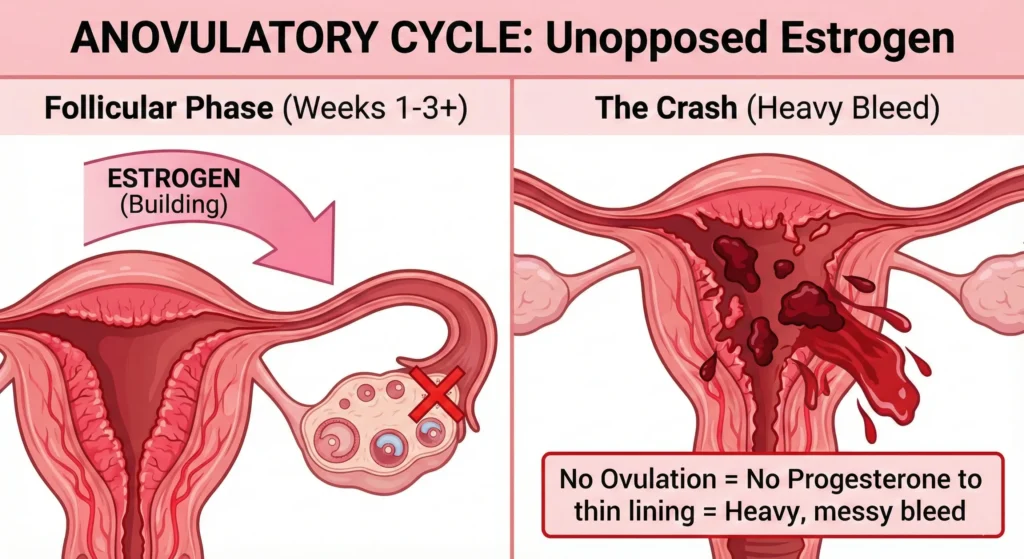
Both teens and perimenopausal women experience ‘Anovulatory Cycles’ (bleeding without releasing an egg). Because no egg released, no Corpus Luteum formed, and no Progesterone was made. This leads to ‘Unopposed Estrogen.’ Estrogen keeps building the uterine lining thicker and thicker until it becomes unstable and crashes out as a very heavy, sometimes painless, but messy bleed. This is a hallmark of both life stages.
🎓 Test Your Knowledge
1. When does Perimenopause usually start?
See Answer
It starts long before periods actually stop.
2. Why are first periods often irregular?
See Answer
The brain and ovaries are learning to communicate.
Medical Disclaimer: This content is for informational purposes only and is not a substitute for professional medical advice, diagnosis, or treatment.