Introduction: The "Grab-and-Go" Appeal
You’re rushing to work, cramps are starting to kick in, and you grab a sticky heat patch from the drugstore shelf. It seems like the perfect quick fix. They are discreet, they stick to your underwear, and they don’t need to be plugged in.
But have you ever wondered what’s actually inside that patch? Or why it sometimes feels like it’s burning your skin, only to go cold an hour later? While disposable heat patches have their place, relying on them as a long-term solution comes with hidden downsides—for your wallet, your safety, and the planet.
The Pros: Why We Use Them
Let’s be fair—there are reasons why these patches are popular.
- Discreet: They are thin and can be worn under clothes without anyone noticing.
- Portable: You can keep one in your purse for emergencies.
- Availability: You can buy them at almost any pharmacy or supermarket.
The Cons: Unstable Heat & Safety Risks (H2)
The technology inside a disposable patch is simple chemistry: Iron Oxidation. When you open the package, iron powder reacts with oxygen in the air to create heat. The problem? This reaction is notoriously hard to control.
- Temperature Fluctuation: The heat output depends on airflow. If you wear tight jeans, the patch might not get enough oxygen and stay cold. If you loosen your clothes, it might get a sudden rush of oxygen and spike to dangerous temperatures (often exceeding 50°C/122°F), posing a risk of low-temperature burns1.
- Short Lifespan: Most patches claim to last 8-12 hours, but the “therapeutic level” (40°C+) often drops off much sooner, leaving you with a lukewarm sticker.
- The “Subscription” Model: A box of 3 patches costs about $5. If you use 2-3 boxes per cycle, that’s ~$180 a year. Over 20 years, you’re spending $3,600 on trash.
The Environmental Cost: A Mountain of Trash (H2)
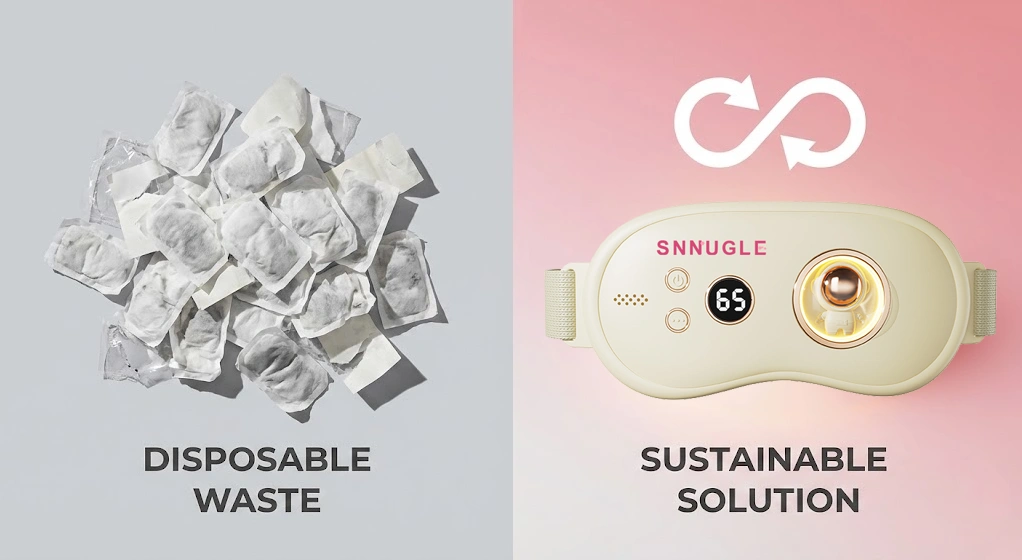
This is the part we rarely think about. Disposable patches are single-use plastics in disguise.
- Non-Recyclable Ingredients: The pouch contains a mixture of iron powder, activated charcoal, vermiculite, and salt. Once the chemical reaction is done, this mixture cannot be recycled and ends up in landfills.
- Plastic Waste: Each patch comes individually wrapped in plastic, plus the adhesive backing layer.
- The Scale: If a woman uses 10 patches per cycle for 35 years, that is 4,200 patches sitting in a landfill from just one person.
The Solution: Sustainable & Smart
If you care about sustainability (and your bank account), it’s time to switch to a reusable solution.
Contextual Integration:
This is where the Snnugle Warmer shines as a modern, eco-friendly alternative.
- One Device, Years of Relief: Instead of buying patches every month, you invest once. It reduces your carbon footprint significantly.
- Stable Safety: Unlike the unpredictable chemical reaction of iron patches, Snnugle uses NTC sensors to maintain a precise, safe 40-45°C. No surprise burns, no “dud” patches.
- Skin-Friendly: No more ripping sticky adhesive off your favorite underwear or irritating your skin with glues. You get consistent, comforting heat that is kind to your body and the earth.
FAQ Section
Q1: Are heat patches safe to sleep with?
A: Generally, no. Because the chemical reaction can spike in temperature unexpectedly, sleeping with a disposable patch increases the risk of “Toasted Skin Syndrome” or burns, as you might not wake up in time to remove it2.
Q2: Can I recycle used heat patches?
A: No. The internal components (iron/charcoal mix) are considered general waste. While the outer cardboard box might be recyclable, the patch itself and its plastic wrapper must be thrown in the trash.
Q3: Is a reusable warmer bulky under clothes?
A: Modern devices like Snnugle are designed to be ultra-slim and curved to fit the body. While slightly thicker than a paper patch, they are sleek enough to be worn discreetly under a sweater or loose top.
Conclusion
Disposable patches are the “fast fashion” of pain relief—convenient in the moment, but costly and wasteful in the long run. By switching to a smart, reusable warmer, you aren’t just choosing better pain management with stable heat; you are making a choice that respects your wallet and protects our planet.
Read Next
- Chapter 4: Menstrual Phase: Pain Management & Deep Restoration
- Smart Warmer vs. Hot Water Bottle: Why Temperature Stability Matters
- What is “Toasted Skin Syndrome”? How to Avoid Low-Temperature Burns
-
References
[1] Tadi, P., et al. (2022). Burns Sustained From Body Heating Devices. Wounds.
[2] Riahi, R. R., & Cohen, P. R. (2021). Erythema ab igne: A review of the literature. American Journal of Clinical Dermatology.
Medical Disclaimer: This content is for informational purposes only and is not a substitute for professional medical advice, diagnosis, or treatment. Always seek the advice of your physician or qualified health provider with any questions you may have regarding a medical condition.

 Key Takeaways