
Chapter 1 The Science of Your Cycle: The Hormone Dance
🕒 6 min read | Last Updated: [Date]
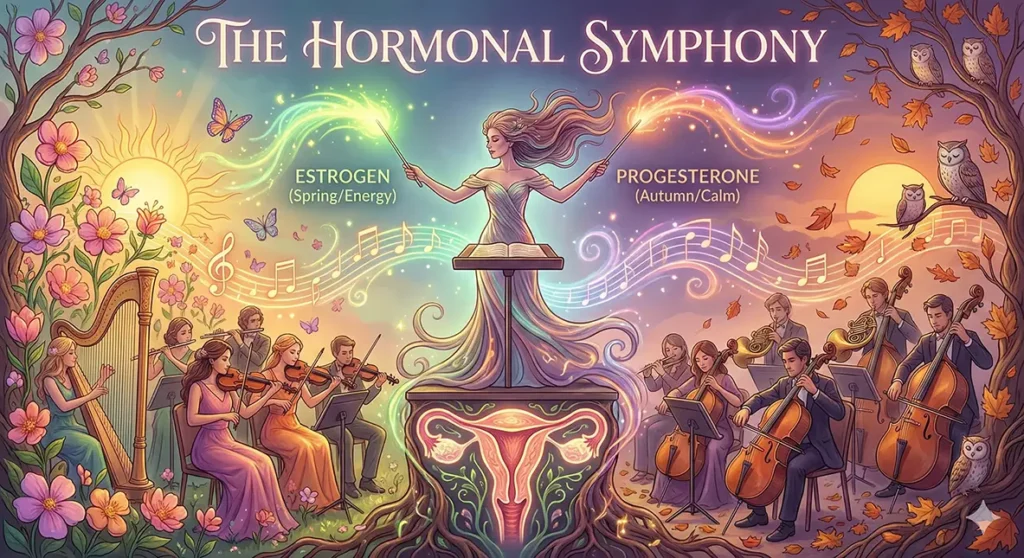
Imagine an orchestra inside you.
Have you ever wondered why you feel like Beyoncé one week—ready to conquer the world, crush your presentation, and socialize until midnight—and the next week, you just want to curl up with a heating pad, cancel all plans, and cry over a commercial?
It’s easy to think, “I’m just being emotional,” or “Why am I so inconsistent?”
Here is the truth: You are not inconsistent. You are cyclical.
Your body is not a static machine that operates the same way 24/7 . Instead, your reproductive system is conducting a sophisticated symphony every single month. This biological rhythm is orchestrated by chemical messengers called hormones.
In this chapter, we are going to meet the two main conductors of this music: Estrogen and Progesterone. Understanding their “dance”—how they rise, fall, and interact—is the absolute foundation of reclaiming control over your period pain, your energy, and your life.
Once you know the steps of this dance, you stop fighting your body and start moving with it.
 Key Takeaways
Your cycle is a 4-part symphony: It’s not just about the “bleeding phase”; it’s a continuous loop of hormonal shifts that affect your brain, metabolism, and mood.
Estrogen is your “Springtime”: It dominates the first half of your cycle, boosting energy, confidence, and pain tolerance.
Progesterone is your “Autumn”: It dominates the second half, encouraging rest, slowing digestion, and requiring more calories.
The “Crash” causes the pain: The sudden drop of both hormones at the end of the cycle triggers the inflammation (prostaglandins) responsible for cramps.
The Main Characters: Estrogen & Progesterone
Your metabolism actually speeds up, increasing your metabolic rate, which explains those pre-period hunger pangs.To understand why you feel the way you do, we need to look at the main characters. While there are many hormones involved (like FSH and LH, which we’ll geek out on later), the two that dictate your daily reality are Estrogen and Progesterone.
Think of them as the Yin and Yang of your monthly rhythm. They have opposite effects, and your body needs both to be in balance.
1. Estrogen: The “Springtime” Hormone
When she’s in charge: The Follicular Phase & Ovulation (Days ~6 to 14).
After your period ends, Estrogen starts to rise, reaching a dramatic peak just before ovulation. In our “cycle seasons” metaphor, this is your inner Spring and Summer.
Biologically, Estrogen’s job is to thicken the lining of your uterus to prepare a “nest” for a potential egg. But her side effects are what you’ll notice in your daily life:
- Energy & Mood: Estrogen acts somewhat like a natural antidepressant. It boosts serotonin and dopamine in the brain. You might find yourself more optimistic, chatty, and eager to tackle complex projects.
- Pain Tolerance: High estrogen levels are actually linked to higher pain tolerance. This is why you might hit a personal best at the gym during this week without feeling as sore.
- Physical Glow: It stimulates collagen production (hello, glowing skin!) and acts as a natural lubricant for your joints.
2. Progesterone: The “Autumn” Hormone
When she’s in charge: The Luteal Phase (Days ~15 to 28).
Once ovulation is over, Estrogen steps back, and Progesterone enters the stage.This marks the beginning of your inner Autumn.
If Estrogen is the “espresso” of your cycle, Progesterone is the “herbal tea.” Her biological goal is to maintain that uterine lining and keep everything calm in case a pregnancy has occurred. This hormone is a natural sedative—literally.
- The Chill Factor: Progesterone stimulates the production of GABA, a neurotransmitter that promotes relaxation and sleep. If you feel sleepy or “foggy” during these weeks, that’s not laziness; that’s chemistry.
- Metabolism & Temperature: Did you know your basal body temperature rises by about 0.5°F to 1°F during this phase? Your metabolism actually speeds up, increasing your metabolic rate, which explains those pre-period hunger pangs.
- The Bloat: While calming, Progesterone also relaxes smooth muscles—including your digestive tract. This can lead to slower digestion, bloating, or constipation.
3. The “Great Crash”: Why It Hurts
When it happens: Late Luteal / Menstruation (Days ~26 to 28).
This is the critical moment for understanding pain. If you aren’t pregnant, the body realizes it doesn’t need that “nest” anymore.
Suddenly, the music stops. Both Estrogen and Progesterone levels plummet rapidly. This hormonal withdrawal triggers a chain reaction:
- Mood Dip: The sudden drop in hormones can drag your serotonin/dopamine levels down with them, leading to PMS, irritability, or anxiety.
- The Inflammation Trigger: This is key. The drop in Progesterone signals your cells to release chemicals called Prostaglandins. These are inflammatory markers that tell the uterus to contract and shed its lining.
Here is the connection: Higher levels of prostaglandins = stronger contractions = more painful cramps. (Research confirms that women with severe dysmenorrhea often have higher levels of these chemicals).
Understanding this “Crash” is empowering. It means your cramps aren’t a punishment; they are an inflammatory response to a hormonal shift. And the good news? We can manage inflammation through heat, nutrition, and stress management (which we will cover in future chapters).
🔬 For the Science Geeks: The HPO Axis Explained
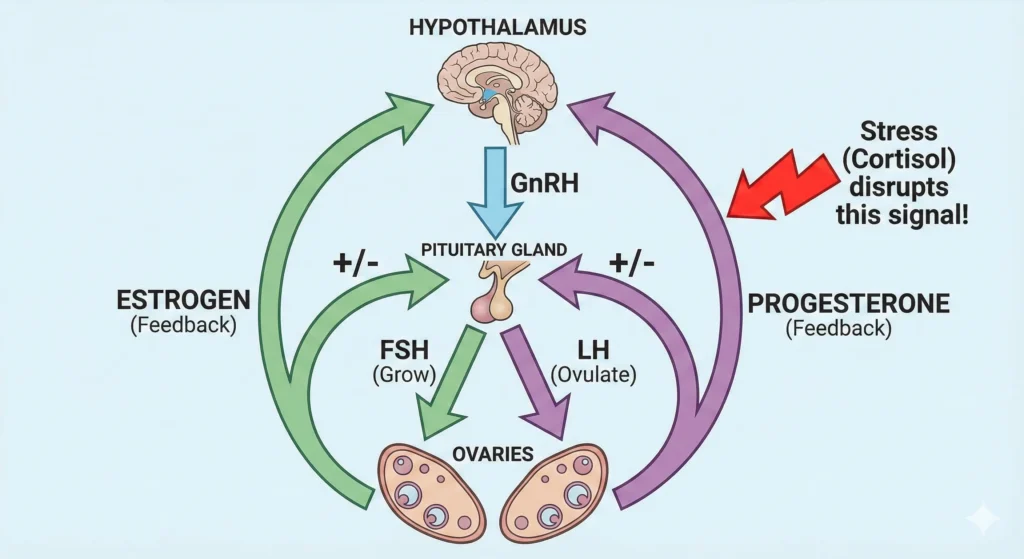
The cycle isn’t just happening in your ovaries; the boss is actually your brain. It is controlled by a feedback loop called the HPO Axis (Hypothalamus-Pituitary-Ovarian Axis).
Hypothalamus: The master control center in your brain releases GnRH (Gonadotropin-Releasing Hormone).
Pituitary: Receiving the signal, it releases FSH (Follicle Stimulating Hormone) to tell the ovaries to ripen an egg, and later LH (Luteinizing Hormone) to trigger the release of that egg (Ovulation).
Ovaries: In response, they produce Estrogen and Progesterone, which travel back to the brain to say “Message received, stop sending signals.”
Stress disrupts this axis because cortisol (the stress hormone) competes with progesterone sites, often leading to irregular cycles or worse PMS.
📖 Dive Deeper with Snny’s Blog
Now you know the science, see how to apply it to your breakfast bowl.
Read Article🛠️ Womb Warming & Daily Care
“It’s not just for cramps. Learn how daily heat therapy improves circulation and combats ‘Cold Uterus’ symptoms.”
Shop Daily Care →🎓 Test Your Knowledge
1. Which hormone is considered the “natural sedative” that might make you feel sleepier in the second half of your cycle?
See Answer
2. Why do cramps usually happen right before or during your period?
See Answer
3. During the Follicular phase (Estrogen rising), you are most likely to feel:
See Answer
Correct Answer: Energetic and social. (Yes! This is your ‘Springtime’ phase where energy and confidence typically peak.)
Medical Disclaimer: This content is for informational purposes only and is not a substitute for professional medical advice, diagnosis, or treatment. Always seek the advice of your physician or other qualified health provider with any questions you may have regarding a medical condition.